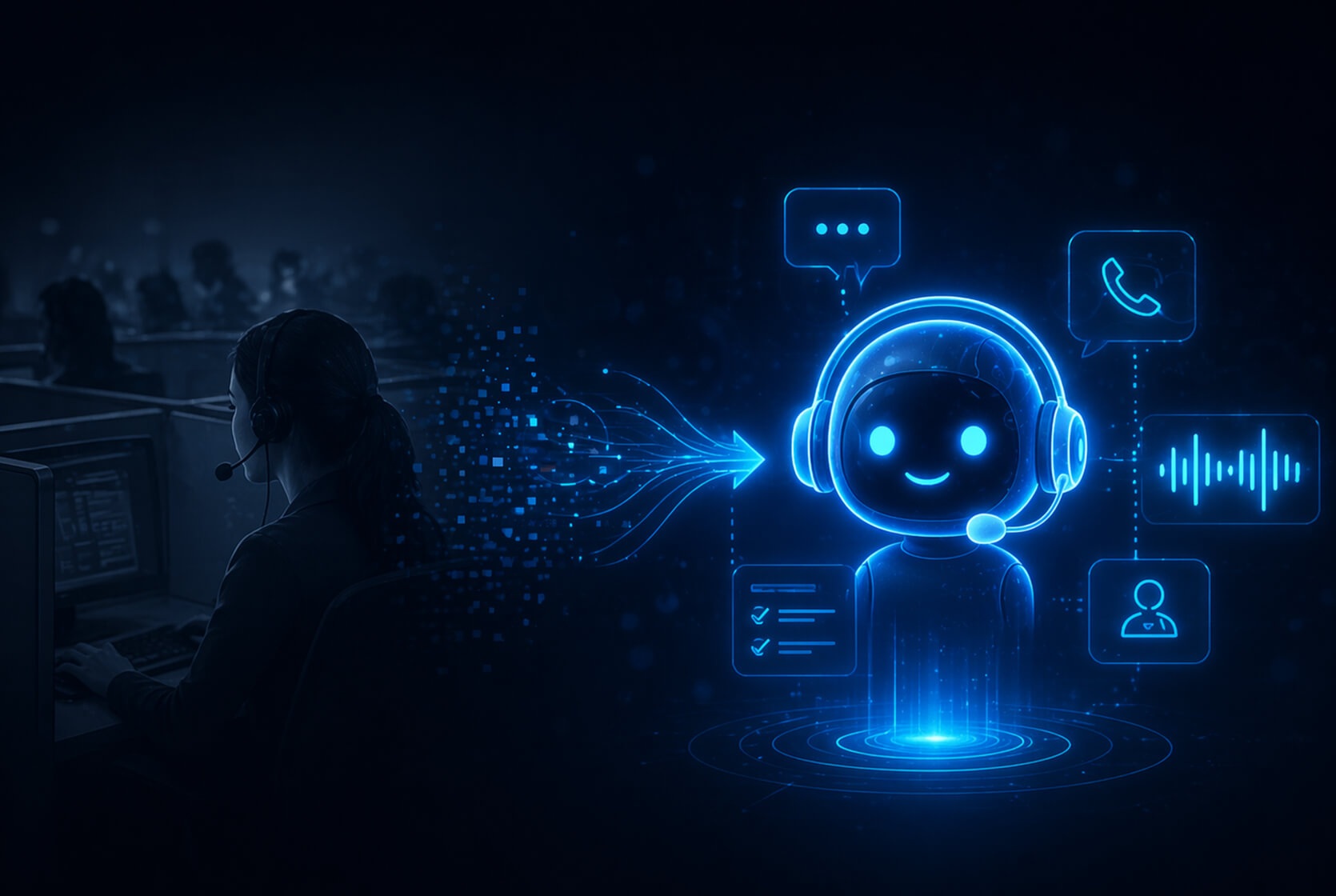


In 2026, customer communication is shifting rapidly as businesses move from traditional call centers to intelligent automation. Rising customer expectations for faster, smoother, and always-available support is pushing companies to rethink how conversations are handled at scale.
Voice AI Agents are becoming the core of this transformation. By combining speech recognition, large language models, and natural voice synthesis, they can understand intent, respond in real time, and manage conversations without constant human involvement.
Unlike older systems like IVR and rule-based routing, these AI-driven agents deliver context-aware, human-like interactions that improve resolution speed, reduce wait times, and redefine how support operations function.
Voice AI Agents are AI-powered systems that interact with users through natural, human-like voice conversations in real time. They are designed to automate conversations that traditionally required human call center agents, making customer interactions faster and more efficient.
Key technologies behind Voice AI Agents:
Traditional call centers are becoming harder to scale as customer expectations grow. Businesses face rising costs, staffing challenges, and service delays, pushing them toward automation solutions like Voice AI Agents for faster and more efficient support.
Running large call centers requires high investment in staffing, training, infrastructure, and maintenance. Costs increase further with scaling, making it difficult for businesses to maintain profitability while ensuring quality service.
Customers often face delayed responses due to limited agent availability. High call volumes lead to long queues, which negatively impact customer satisfaction and increase drop-off rates during support interactions.
Call center roles experience high employee turnover due to repetitive tasks, stress, and workload pressure. This leads to continuous hiring and training cycles, affecting service consistency and operational efficiency.
Modern customers expect round-the-clock assistance across time zones. Traditional call centers struggle to maintain 24/7 coverage without increasing costs, making automation a necessary shift.
Voice AI Agents are transforming call centers by replacing repetitive, manual call handling with intelligent, real-time conversations powered by AI. They enable faster resolution, reduce human workload, and improve customer experience through automation and contextual understanding.
Voice AI Agents manage live customer calls instantly, understanding intent and responding without delay. This reduces wait times and improves first-contact resolution through continuous, uninterrupted interaction flow.
They can resolve common customer issues without human intervention, such as FAQs, account updates, and order tracking, reducing workload on support teams significantly.
AI detects customer intent and routes complex issues to the right department or human agent, ensuring smoother and more accurate escalation processes.
Voice AI Agents provide round-the-clock assistance, ensuring customers receive support anytime without dependency on shift-based human availability.
By replacing large support teams for routine tasks, businesses significantly reduce operational and staffing costs while maintaining service quality.
With natural conversations and quick responses, Voice AI Agents improve satisfaction levels and deliver consistent, reliable customer interactions.
Voice AI Agents are transforming how call centers operate by handling repetitive, high-volume customer conversations with speed and accuracy. From support to sales, they are now being used across multiple customer touchpoints to reduce wait times and improve efficiency.
In 2026, customer support is shifting toward automation, and Voice AI Agents are becoming central to this change. They are replacing repetitive call center tasks with faster, more intelligent, and always-available interactions that improve efficiency and response quality.
Businesses adopting this shift are seeing reduced costs, better scalability, and improved customer satisfaction. Unlike traditional systems, AI-driven voice agents deliver consistent, context-aware conversations across every interaction.
Overall, Voice AI Agents are not just upgrading call centers but redefining how customer communication works, creating a more responsive, scalable, and future-ready support ecosystem.
 1.png)
We're building something powerful for you. This feature will be available shortly.